With the rise of the optical storage industry, inverter functions are becoming more comprehensive and refined, and many categories have been derived, suitable for different application scenarios. In the field of household storage, the current mainstream inverters mainly fall into two categories – hybrid inverters and energy storage inverters.
Hybrid inverter is an inverter product specially developed and designed for household storage and small industrial and commercial storage. It has the most complete functions – it can directly connect to photovoltaic, grid, battery and load, and coordinately control the entire system.
Generally speaking, hybrid inverters are suitable for households that install a complete set of photovoltaic and storage equipment from scratch, or households that only need partial functions for the time being but will consider installing a complete system in the future.
Energy storage inverters, also known as bidirectional converters, are mainly designed for the photovoltaic stock market in the household storage field, that is, customers who have installed photovoltaic systems.
To add an energy storage system to the original photovoltaic system, an energy storage inverter is the best choice. Through AC coupling, the energy storage system can be easily added to the original system.
According to whether it is connected to the grid, energy storage systems are divided into two categories: grid-connected energy storage systems and off-grid energy storage systems.
According to the different voltage types connected to the grid, inverters are divided into single-phase, three-phase, and split-phase inverters. There are three types of inverters. Different application scenarios require different inverters to be selected.
Off-grid energy storage systems are not connected to the grid and operate completely independently of the grid, so there is no need for an inverter with grid-connected functionality.
In this application scenario, you can choose an off-grid hybrid inverter, which is mainly suitable for remote areas such as deep mountains and offshore islands without power grid, or for families experiencing off-grid life.
Grid-connected energy storage systems need to be connected to the grid, take power from the grid or even send power in reverse, and interact with the grid, so there are many safety protection requirements and technical standards. The power grid conditions in different countries and regions are different.
Some areas use three-phase power, and some areas use single-phase power or split-phase power. Even the power grid conditions in different regions of the same country are different. Therefore, it is necessary to reasonably adjust the power grid according to the local power grid conditions.
In addition, the grid connection of the inverter also involves grid connection certification. Most countries have independent grid connection certification standards. The inverter must meet local certification requirements before it can be connected to the grid for operation.
Otherwise, it may face fines from the power grid company. It should be noted that as long as the inverter is connected to the grid, regardless of whether it draws or uses electricity, it needs to obtain grid connection certification.
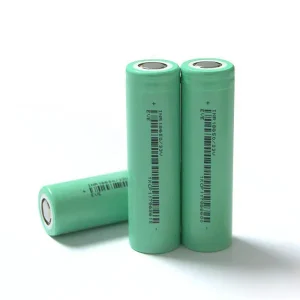
Inverters and energy storage batteries need to be compatible with each other to ensure the safe and reasonable operation of the entire photovoltaic storage system.
Energy storage batteries are divided into two categories: high voltage and low voltage, and corresponding inverters also have corresponding voltage compatible types, namely high voltage inverters and low voltage inverters.
Low-voltage inverters are suitable for low-voltage energy storage batteries, and the compatible voltage range is usually 40-60V; high-voltage inverters are suitable for high-voltage energy storage batteries, and the compatible voltage range is 90-600V or more.
In addition to voltage, the communication protocol needs to be adapted between the inverter and the battery. Otherwise, the inverter will not be able to correctly read the battery data, resulting in the inability to effectively monitor the battery.
Usually the communication protocols between brands are different, but for reasons such as business cooperation and market demand, manufacturers of various brands will adapt communication protocols to each other.
Therefore, when purchasing inverters and batteries of different brands, be sure to make sure the two match each other. Information on inverter and battery shop near me may can help you about how to buy one.
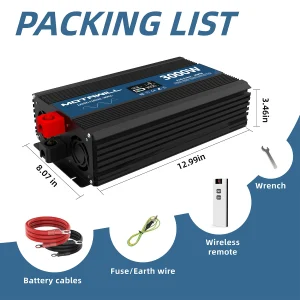
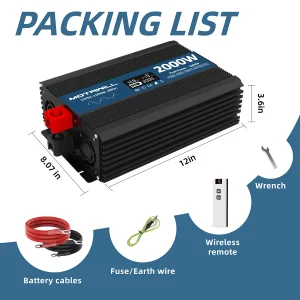
Experience the pinnacle of power management with the Motawill inverter!
This state-of-the-art device is the culmination of extensive research and rigorous testing. It is designed to meet the highest safety standards, as evidenced by its compliance with ETL safety regulations and multiple certifications such as UL458, PSE, CE, FCC, and more.
One of the main highlights of the Motawill Inverter is its voltage stabilization function. It provides a stable voltage, which is crucial for the safety and longevity of your electronic devices. In addition, it has a low no-load current of 0.6A, minimizing battery loss and enhancing performance over extended periods.
The interactive LED display is another noteworthy feature. It not only displays crucial information in real-time such as power, input voltage, output voltage, and battery status, but it also allows for customization. You can personalize the boot animation and logo according to your preference. The displayed information is highly accurate, with an impressive accuracy rate of 98%, which is among the highest in the industry.
In summary, the Motawill Inverter is a reliable, efficient, and innovative solution for all your power management needs. It combines safety, performance, and convenience in a compact that you can trust.